Sunday, August 8, 2010

Pavlof Harbor


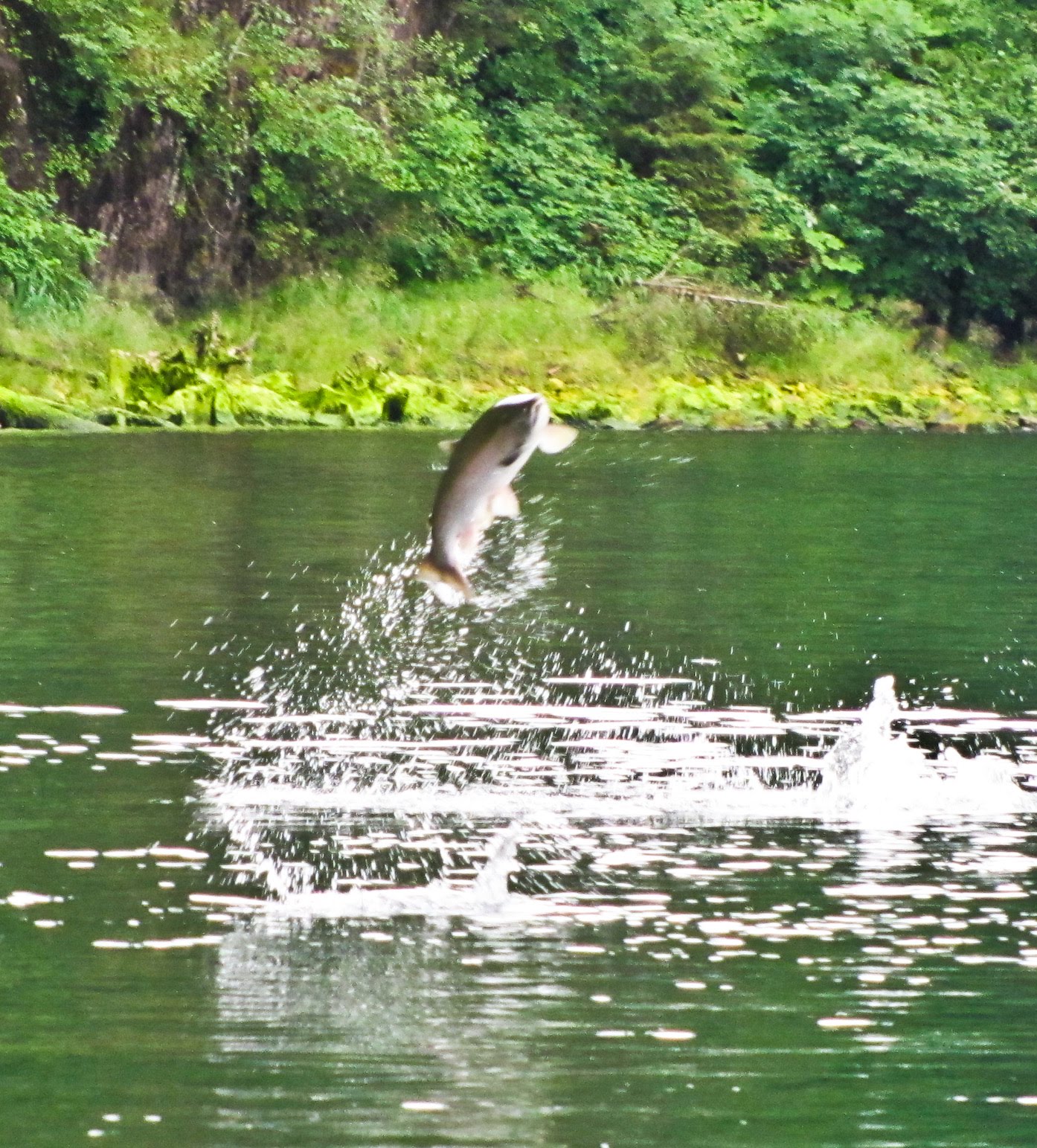
Just the name Pavlof floods my brain with vivid memories from this special location. We usually anchor within sight and sound of the waterfall where several species of returning salmon jump and splash noisily, non-stop throughout the bay, and deer and grizzly frequent the shallows and the shore. There’s always the expectation of great fishing and endless photo opportunities.

Well, the weather was calm and the fishing was hot! On our first fishing trip we ran about 3.5 miles outside the bay in the skiff, hooked some rockfish, caught five salmon (drat! lost a big one), and brought three large coho back to the big boat. All that in less than three hours.


Three big coho - that’s the good news. The freezer is almost full - that’s the not-so-good news. We need to eat a lot of fish before we go fishing again. We’re up to the challenge with barbecued salmon for dinner, salmon salad for lunch, and lox curing in the refrigerator for snacks and appetizers in the days ahead.


Salmon jumped all over the bay, dotting the surface with splashes like popcorn kernels exploding in a hot skillet.

Ron couldn't resist the lure of all those the jumping salmon and had to bring back just one more coho. Check out that smile as he singlehands the fishing and netting.


Hundreds of returning pinks and coho fought their way through the shallows and leapt up the steps in the concrete fish ladder, battling the torrents of water rushing down from Pavlof River and Lake. All of those fish, and only one grizzly?! I fear that popularity has spoiled changed this special place.

Pavlof has become a heavily scheduled destination for small cruise ships and smaller charter boats. We observed 75-passenger ships anchor by 8:00 a.m. and efficiently launch a handful of large rubber rafts and a flotilla of kayaks. The rubber rafts transported the guests ashore to hike to the falls, take a naturalist-guided walk to the lake, kayak around the bay, hopefully photograph some wildlife, and generally enjoy an Alaskan wilderness experience. By 1:00 p.m. the guests, kayaks, and rafts were recovered and the ship cruised out of the bay. Evidently grizzly bear are not fond of crowds, since they hid and didn’t join the party.


We did see one lone grizzly, a youngster, who chased salmon each day at dawn and dusk. His capturing skills needed a lot more practice.


Do you suppose the bear have moved up the canyon, where the streams run into Pavlof River, to feed undisturbed by all of us visitors? Has hunting made them more wary along the shoreline? Are they still inland, eating berries and grass due to late-returning salmon runs?  I especially wonder what happened to the sow and her two beautiful blond cubs that we saw last year at this time. 


Tuesday, August 3, 2010

Baby Bear Bay


We spotted two humpbacks on the thirty-mile run from Sitka Harbor to Baby Bear. One whale worked the currents east of Kakul Narrows and the second one was feeding east of Sergius Narrows, close to Deep Bay. No surprise, we frequently spot a lone whale in both locations. Note: Baby Bear pops up frequently in the cruise notes, and with good reason. It's a convenient spot to moor and wait for slack current at Sergius, or to anchor after a late-in-the-day trip through the Narrows. It's also a nice bay, and conveniently located across the channel from great crabbing and bear watching in Deep Bay.

Early Wednesday morning, just minutes after we upped anchor and navigated a careful exit from Baby Bear Bay, I was on the bow for photos of an approaching tug with barge as it cleared the Middle Point channel markers.


It was a still, quiet morning with only a low rumble of boat engines breaking the silence. Surprise! a whale surfaced and spouted noisily right next to the boat. One more blow and then he was gone. It took a few minutes for my racing pulse to slow back to normal. That was a great way to begin a day, but I wish I had captured more than whale spray in a photo.


Monday, August 2, 2010

Sitka Harbor


A working harbor is a busy place. When the seine boats are tied up, in between openings, there is a major focus on maintenance and repair. A neighboring seiner's crew spent long hours over a couple of days working on their net, checking for tears and repairing each hole by hand. What a lot of net area to check, typically 1200 feet long by 40 feet deep, but nets are an expensive and critical piece of equipment.


In the midst of net repair and boat prep, there's always time for fun on board when the family comes to visit.


What happens to all of the salmon that are hauled aboard in a seine net? Most seiners transfer their fish to a packer (also called a tender). This pair were busy doing just that inside Sitka's breakwater. 

Photo: packer Peggy Jo on the left, seiner Defiant on the right

Photo: the large vacuum tube sucks water and fish out of the seiner's hold and pumps them into the packer. 

A working boat of a different type, this tour boat utilizes underwater viewing ports to give its passengers a glimpse of aquatic life. A scuba diver will frequently rendezvous with the boat and hand feed a variety of fish. It's a popular tourist attraction, and keeps busy when the cruise ships are in port.


We do spend some time away from the docks (and not just at the grocery or the marine supplier). This year we  revisited the Sheldon Jackson Museum. 
"If there were a museum for museums, the Sheldon Jackson Museum in Sitka would be part of the collection. It is the oldest museum in Alaska and is located in the first concrete building in the state. Construction began in 1895 and it has been occupied since 1897. The building was placed on the National Historical Register in 1972.
While the building may be as old as some of the items in its collection, its exhibits reflect recent renovation and a dedication to professional museum standards. The Museum's collection has been called a jewel in the crown of Alaska ethnographic collections."
The collected artifacts were interesting and well displayed, but we most enjoyed the time spent with Margaret, a traditional beadwork artist, and the several docents on duty who added so much life to the experience.


 Photo: traditional Tlingit headpiece with abalone shell and ermine tails