Showing posts with label boats. Show all posts

Sunday, July 19, 2015

Baranof Warm Springs


For an Almost Wordless Wednesday: a fish tote boat at Baranof Warm Springs.


Thursday, December 5, 2013

Under Cover for the Winter?

Not the Rhapsody


How do you protect a boat from the worst effects of winter weather? Without storing a vessel in a boathouse, local boat owners use a variety of methods to deal with the occasional winter snow, and the more common ice and driving rain in the Pacific Northwest. Recently the daytime air temperatures have dipped below freezing, but the saltwater has maintained a steady 43-44 F throughout the week. This makes it possible to leave boats in the water for the winter, rather than hauling them out to store on the hard.

Most boats are left open to the weather, hopefully watertight and leakproof. Other vessels sport tidy canvas covers, casual tarps, industrial grade polysomething shrink-wrapping, and more. On a sunny Autumn day the covered boats remind me of postponed adventures, parked on some mental shelf until… who knows when?


Thursday, July 12, 2012

Seiners at Work


At 5:00 a.m. scores of seiners dotted the water in mid Chatham Strait for a one-day salmon opening. There were upwards of 80 seine boats vying for their share of the chum salmon returning to the Hidden Falls hatchery. We ran over from Ell Cove in our skiff and spent several hours following a number of boats through multiple cycles as they set and recovered their nets. Old boats, remodeled old boats, and newer boats all jockeyed for position and worked nonstop from the opening to the 10:00 p.m. closing. It was fascinating to watch, and led to a new appreciation of the skill and energy involved.
  • Position the skiff and string out the net
  • Let it soak for 20 minutes
  • Circle and recover, neatly stacking the heavy net, separating corks
  • and weights, close the purse, haul the catch aboard and into the chilled hold – and accomplish all of this in 12 to 13 minutes
  • Pick your new location and begin a new set 
Here are a few shots from the day


This was a warm, sunny day in calm water. Now imagine fishing in cold, stormy weather with challenging sea conditions.

Thursday, May 31, 2012

Water Taxi as Nursery


I've written before about our dockside neighbor, Way West Water Taxi, and the colorful people and interesting freight they transport every day. Recently it was the colorful freight that caught my attention. Truckloads of nursery plants were unloaded in the parking lot, wheeled down the ramp in hand trucks or carried by hand. Load after load of pots, flats, hanging baskets and trees began to pile up. This colorful mix stacked along the main dock waiting for a packing wizard to figure out how to fit this large volume of squishable cargo inside a small space. I felt certain it would take more than one workboat to carry that quantity of nursery stock. The main dock was so well decorated that I hoped it would take several days.
Photo: plants hung overhead, filled the seats, aisle and luggage racks
But no, the plants kept disappearing into hatches, into the cabin, into spaces I couldn't see. In no time at all the dock was empty, not one bit of landscaping left. How do you fit truckloads of plants into one workboat??? I went to the Way West website and read about 5000 lb. payloads and large storage capacity, but that still seemed like a lot of nursery stock to fit into one boat. Magic perhaps?


Photo: Dave doesn't look worried, he knows it will all fit... somewhere
Photo: there was plenty of room for plants, passengers, luggage, freight, a driver and a dog

Wednesday, September 14, 2011

Rain, Wind, Fog, and More Rain, etc.


Mid-August
You've read the title, you get the picture. Our run south was gray and wet, but that's just the big picture. There were interesting moments along the route.

Petersburg Harbor bustled with activity as seiners and packers returned with holds full of salmon, and then set out again for the fishing grounds. 
Seiners filled these docks, but trollers and gillnetters were active too.
The canneries ran full shifts, filling the bay with foamy effluent and the air with the aroma of cooked seafood (and more). Schools of herring swarmed the waters and screeching gulls and eagles whirled through the air everywhere. Just picture eagles playing fighter pilot as they maneuvered in the harbor; twisting, diving and pulling up rapidly to avoid masts and rigging while they plucked herring from the water's surface or tried to steal fish from another bird. That was some air show.


Occasional small icebergs drifted past the docks, carried up and down the channel by the swift-moving current.


Wrangell Narrows is a crooked, doglegged waterway that is dotted with a maze of markers which indicate the navigable main channel and several side channels. Easy to transit in clear weather, it's a bit more challenging in heavy rain and/or fog. Our onboard navigation program and radar were much appreciated in August's changeable conditions.

You don't want to travel on the wrong side of a marker.
The view forward.
The view aft.
The view on the radar screen... somewhat later.
Here's an unfortunate vessel; did the captain misread the markers, or run afoul of a hard-to-see gillnet? That's a troller - trollers don't fish with nets, but there is one hanging over the rear quarter.

Click on the photo for a better look at the net.
High winds and rough water in Sumner Strait caused a change in the cruise plan. A long run was scrubbed in favor of a short dash across the strait into St. John Harbor. With extra storm lines added to the usual complement of mooring lines, we rode out the gale pointed up into the winds at a Forest Service dock. Forty-knot winds howled through our bay, 60-70 knot gusts were recorded nearby in Clarence Strait. While we were comfortable and secure, it was worrisome to watch two big boats anchored across the bay as they rolled and pitched, swinging in 180 degree arcs around their anchors.


Zarembo Island's streams ran fast and dumped muddy water and scads of debris into the bay. Here's one log chunk rushing past the dock - I hoped we didn't meet up with this one or any other as we traveled on. 


Saturday, June 25, 2011

Leaving Ketchikan


June 16
Tatoosh Island, in Behm Canal

As we cruised slowly along Tongass Narrows at the prescribed no-wake speed, we were startled to see two orange Coast Guard RIBs roar by at top speed. The speed was surprising enough, but in each boat a Coastie manned a large pedestal-mounted 50-caliber machine gun. The radio crackled with transmissions informing the captain of the cruise ship Zuiderdam that his ship would be met by USCG Security Escorts and accompanied to its assigned berth. What?!! should we be worried? It turned out to be a drill.


Click on the photo to get a better look at Homeland Security in action.
Tatoosh Island anchorage was peaceful and deserted when we anchored, but we had entertainment throughout the day. A kayak touring company operates out of the bay, zipping back and forth to Ketchikan in several large RIBs to transport boatloads of cruise ship tourists, all eager for a wilderness adventure. 


The best part of the day was a brief fishing trip, 45 minutes from start to finish. RL caught a really nice salmon - and I did a super job of netting it, of course. Now that’s my kind of fishing trip, short and effective. Iron Skillet Salmon (link) for dinner and a big batch of lox (link) in progress. 


Tuesday, June 14, 2011

At the Dock - Seine Boats


Ketchikan Harbor was bustling and crowded when we arrived. The final weekend of a fishing derby brought a lot of boats - no doubt the $10,000 in prize money and bragging rights were attractive lures. Cruising boats of all sizes were in Ketchikan to clear Customs and provision on the way north. Seiners from Washington and Alaska were readying boats and equipment for a king salmon opening.


Some of the seiners sported new paint jobs, even some awesome varnish work. Others hadn’t bothered. There was a lot of equipment tuning and net repair going on everywhere.


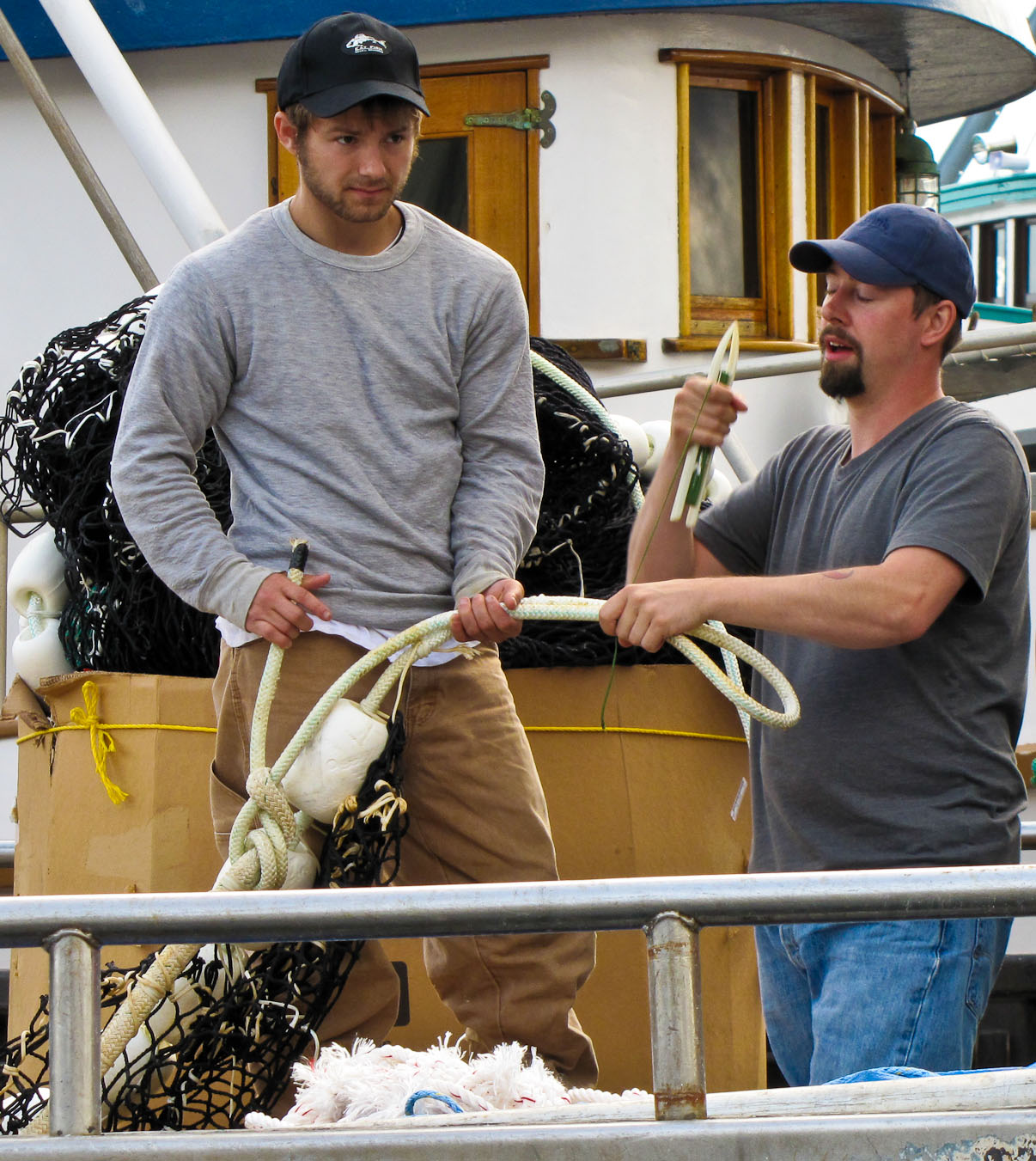
Several seiners still had to load nets - what appeared to be acres and acres of nets - onto their empty sterns. Foot by foot the noisy power blocks lifted nets while crew members inspected every bit of them for needed repairs. Occasional shouts filled the air as experienced crew encouraged the new guys with directions on appropriate methods for handling floats and stacking nets.


Seine skiffs buzzed about the docks, like so many noisy mosquitos... and no, they aren't equipped with mufflers. Some of them were loaded with stacked piles of boxed groceries, others ferried crew members on latte runs.   


Then the seiners began to pull out, a few boats at a time, traveling north along Tongass Narrows as they headed out to the fishing grounds. By the next morning only a handful of seiners remained at the dock. I wonder, when and where the king opening is scheduled? And will the few remaining boats get organized and head out to participate?


Monday, August 2, 2010

Sitka Harbor


A working harbor is a busy place. When the seine boats are tied up, in between openings, there is a major focus on maintenance and repair. A neighboring seiner's crew spent long hours over a couple of days working on their net, checking for tears and repairing each hole by hand. What a lot of net area to check, typically 1200 feet long by 40 feet deep, but nets are an expensive and critical piece of equipment.


In the midst of net repair and boat prep, there's always time for fun on board when the family comes to visit.


What happens to all of the salmon that are hauled aboard in a seine net? Most seiners transfer their fish to a packer (also called a tender). This pair were busy doing just that inside Sitka's breakwater. 

Photo: packer Peggy Jo on the left, seiner Defiant on the right

Photo: the large vacuum tube sucks water and fish out of the seiner's hold and pumps them into the packer. 

A working boat of a different type, this tour boat utilizes underwater viewing ports to give its passengers a glimpse of aquatic life. A scuba diver will frequently rendezvous with the boat and hand feed a variety of fish. It's a popular tourist attraction, and keeps busy when the cruise ships are in port.


We do spend some time away from the docks (and not just at the grocery or the marine supplier). This year we  revisited the Sheldon Jackson Museum
"If there were a museum for museums, the Sheldon Jackson Museum in Sitka would be part of the collection. It is the oldest museum in Alaska and is located in the first concrete building in the state. Construction began in 1895 and it has been occupied since 1897. The building was placed on the National Historical Register in 1972.
While the building may be as old as some of the items in its collection, its exhibits reflect recent renovation and a dedication to professional museum standards. The Museum's collection has been called a jewel in the crown of Alaska ethnographic collections."
The collected artifacts were interesting and well displayed, but we most enjoyed the time spent with Margaret, a traditional beadwork artist, and the several docents on duty who added so much life to the experience.


 Photo: traditional Tlingit headpiece with abalone shell and ermine tails


Sunday, August 1, 2010

Cruising the Outside Waters


Outside waters, that’s what NOAA Weather calls this region of SE Alaska. If you look west you can see Kamchatka. No, not really... Kodiak Island and the Aleutians would get in the way. But trust me, it looks like an empty horizon where you can see the edge of the earth. Southern Baranof Island has some of the most stunningly gorgeous scenery in SE Alaska. The western coastline is rugged, with narrow fjords running inland for miles between towering, jagged mountains. Crashing surf from the Gulf of Alaska buffets the seaward side of the many small islands and the entrances to the fjords. It is gorgeous in the sunshine, and almost ghostly in the fog.


We have explored a portion of this coastline before, but were turned back by wind and high seas, boat issues, or a schedule that wouldn’t allow for waiting out the weather. This year we had a good weather window, with predicted reasonable seas and no fixed schedule. But weather is an ever-changing issue, so we kept our cruise plan flexible.

We traveled south from Sitka along the coast between Cape Edgecumbe and Cape Decision, running inside the protection of small islands whenever possible. We stayed inshore, out of the big water, and had the choice of running into any of the many sheltering inlets and bays if the winds blew up unexpectedly.


Many boaters love to travel outside in the open ocean, but I favor the security of the inside/outside route, even if our path has us winding through small, intricate passages. Some of these passages were narrow, winding and so shallow that I declared we don't need to do that again! The captain didn't comment (smart man).


Photo: First Narrows, a reasonable passage

Salmon runs were miles offshore and so were most of the fishermen (except for us) . A few trollers worked the inshore area, but we only saw a handful of boats during the week. We didn't see any other cruising boats.


Photo: Capt Ron patiently waits for fish, I brought a book and a camera

The locals report that a burgeoning sea otter population is wiping out the crab along the coast. That may be true, but it's hard not to love these comical creatures. Drat! They always manage to stay just out of range of my camera's 20x zoom - how do they know?


Photos: remember to double-click to enlarge the images.


Photo: more than 100 otter, too many to fit in one image!

Goddard Hot Springs, Dorothy Pass, Big Bay, First and Second Narrows, Scow Bay, Shamrock Bay, West Crawfish Inlet, President Bay, Cedar Pass, Herring Bay, Redoubt Bay, Kidney Cove... each one was uniquely impressive, and we were only a third of the way to Cape Decision. Then the weather forecast changed, and we returned to Sitka ahead of the forecast storm with predicted fourteen foot seas. The boat can handle lumpy water, but it's just not fun.

(Note: the weather front stalled for a few days, but turning back was still a good decision. We'll try again another year.) 


Photo: this deer was curious, coming out of the brush to watch us.

Photo: Bald eagles are easy to spot everywhere... look for the round white spots.

Photo: Seals basking in the sunshine.